Bookkeeping is the financial backbone of every small business in Australia. For entrepreneurs in Brisbane, understanding how bookkeeping works is not just about compliance—it directly impacts cash flow, tax efficiency, and long-term business growth. Whether you are a startup, sole trader, or growing SME, professional support in Bookkeeping and Accounting Brisbane can make financial management significantly more structured and stress-free.
In this guide, we break down how bookkeeping works for Australian small businesses in Brisbane, the key processes involved, and why working with experts like Milan Accountants can improve accuracy and decision-making.
1. Understanding Bookkeeping in Brisbane Small Businesses
Bookkeeping is the structured process of recording, organizing, and maintaining all financial transactions within a business. For small businesses in Brisbane, this function is not just an administrative task—it is the foundation of financial stability, tax compliance, and long-term planning. Every invoice issued, expense incurred, payment received, or bill paid contributes to a business’s financial story.
In the context of Bookkeeping and Accounting Brisbane, bookkeeping serves as the first layer of financial management. Without accurate bookkeeping, accounting insights become unreliable. Brisbane businesses—ranging from retail stores and cafés to construction firms and digital startups—rely heavily on consistent record-keeping to ensure they meet Australian Taxation Office (ATO) requirements.
Modern bookkeeping is no longer manual. Most Brisbane businesses now use cloud-based tools such as Xero, MYOB, or QuickBooks. These systems allow real-time tracking of financial data and reduce human errors. This shift has made bookkeeping more accessible for small business owners who may not have formal accounting training.
For small businesses, bookkeeping answers critical questions:
- Is the business profitable?
- Where is money being spent?
- Are customers paying on time?
- Are taxes being correctly calculated?
Professional firms like Milan Accountants support Brisbane businesses by ensuring that bookkeeping systems are correctly set up and consistently maintained. This prevents financial mismanagement and ensures that business owners always have a clear picture of their financial health.
Ultimately, bookkeeping is not optional—it is essential infrastructure for every successful business operating in Brisbane’s competitive market.
2. Core Bookkeeping Process for Australian Businesses
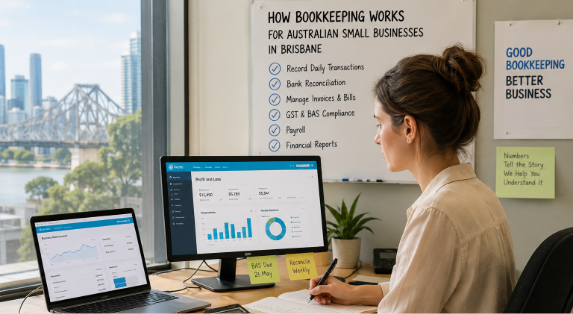
The bookkeeping process for Australian small businesses follows a structured workflow designed to ensure accuracy, compliance, and financial clarity. In Brisbane, businesses must align their bookkeeping practices with ATO regulations, GST requirements, and payroll compliance laws.
The process begins with daily transaction recording. Every financial activity—sales, purchases, expenses, and payments—is documented either manually or through cloud accounting software. This ensures that no financial movement goes untracked.
Next comes bank reconciliation, one of the most important steps in bookkeeping. Here, recorded transactions are matched with bank statements to ensure consistency. Any discrepancies are identified and corrected immediately. This step is essential in maintaining reliable financial records within Bookkeeping and Accounting Brisbane services.
Another critical component is accounts payable and receivable management. This involves tracking money owed by customers and payments due to suppliers. Efficient management ensures healthy cash flow, which is crucial for small business survival.
Businesses registered for GST must also manage BAS (Business Activity Statement) preparation. This includes calculating GST collected and paid, ensuring compliance with strict ATO deadlines, and avoiding penalties.
Finally, bookkeeping includes financial reporting, where key statements such as profit and loss reports, balance sheets, and cash flow statements are prepared. These reports allow business owners to make informed decisions about growth, investment, and cost control.
In Brisbane, firms like Milan Accountants streamline this entire process by integrating bookkeeping systems with accounting strategies. This ensures businesses not only maintain records but also understand what those records mean for future growth.
3. Role of Accounting and Financial Interpretation
While bookkeeping focuses on recording financial data, accounting focuses on interpreting that data. For small businesses in Brisbane, this distinction is extremely important. Bookkeeping provides the raw numbers, but accounting transforms those numbers into actionable insights.
Within the framework of Bookkeeping and Accounting Brisbane, accounting involves analyzing financial statements, identifying trends, forecasting future performance, and ensuring compliance with taxation laws. It bridges the gap between daily financial activity and long-term business strategy.
For example, a bookkeeper may record sales data, but an accountant will analyze whether those sales are profitable after considering expenses, taxes, and operational costs. This analysis helps business owners understand whether their pricing strategy is effective or needs adjustment.
Accounting also plays a key role in tax planning and compliance. In Australia, businesses must comply with GST, PAYG withholding, superannuation obligations, and annual tax returns. Accountants ensure that businesses not only comply but also optimize their tax position legally.
Another major function is financial forecasting. Accountants help predict future revenue, expenses, and cash flow trends. This is critical for Brisbane SMEs planning expansion or managing seasonal fluctuations.
Professional firms like Milan Accountants provide integrated bookkeeping and accounting services, ensuring that financial data is not only accurate but also strategically useful. This combination allows Brisbane businesses to make informed decisions based on real financial insights rather than assumptions.
In essence, accounting turns bookkeeping data into business intelligence. Without accounting, bookkeeping remains incomplete; without bookkeeping, accounting lacks foundation.
4. Cloud Bookkeeping and Modern Tools in Brisbane
The evolution of digital technology has transformed bookkeeping for small businesses in Brisbane. Traditional paper-based systems have been replaced by cloud accounting platforms that offer real-time access, automation, and enhanced accuracy.
In modern Bookkeeping and Accounting Brisbane practices, cloud tools like Xero, MYOB, and QuickBooks are widely used. These platforms allow business owners to track income, expenses, invoices, and payroll from anywhere, at any time.
One of the biggest advantages of cloud bookkeeping is automation. Transactions can be automatically imported from bank accounts, reducing manual entry and minimizing errors. Invoices can be generated and sent instantly, improving cash flow management.
Another key benefit is real-time financial visibility. Business owners no longer need to wait for monthly reports—they can view updated financial data instantly. This helps in faster decision-making and better financial control.
Cloud systems also improve collaboration between bookkeepers and accountants. Firms like Milan Accountants can access live financial data, ensuring faster reconciliation, reporting, and advisory services.
Security is another important aspect. Cloud platforms use encryption and secure servers to protect sensitive financial data, making them safer than traditional storage methods.
For Brisbane small businesses, cloud bookkeeping is not just a convenience—it is a competitive advantage. It reduces administrative workload, improves accuracy, and supports better financial planning.
As technology continues to evolve, cloud bookkeeping will remain central to modern accounting practices in Brisbane.
5. Common Challenges and How Brisbane Businesses Overcome Them
Despite advancements in tools and services, small businesses in Brisbane still face several bookkeeping challenges. One of the most common issues is inconsistent record-keeping. Many business owners delay entering transactions, leading to inaccurate financial data.
Another challenge is cash flow mismanagement. Without proper tracking of receivables and payables, businesses may struggle to maintain liquidity, even if they are profitable on paper.
GST and tax compliance errors are also frequent. Miscalculations or missed deadlines can lead to penalties from the ATO. This is especially problematic for businesses without professional support in Bookkeeping and Accounting Brisbane.
Payroll compliance adds another layer of complexity. Incorrect superannuation calculations or PAYG reporting can create legal and financial risks.
To overcome these challenges, many businesses in Brisbane rely on professional firms like Milan Accountants. These experts provide structured bookkeeping systems, ensure compliance, and offer ongoing financial monitoring.
They also help businesses implement cloud systems, automate processes, and maintain consistent financial records. This reduces stress for business owners and allows them to focus on growth rather than administrative tasks.
Ultimately, overcoming bookkeeping challenges requires a combination of technology, discipline, and professional expertise.