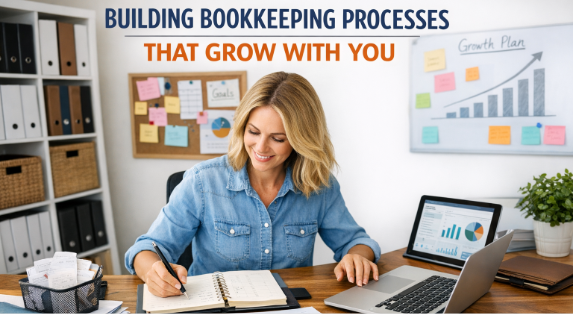
For many businesses, bookkeeping begins as a simple task—recording income and expenses, tracking invoices, and preparing basic financial reports. However, as a business grows, financial operations become more complex. New staff members, higher transaction volumes, expanded services, and increased compliance obligations all require stronger financial systems.
This is why businesses need bookkeeping processes that are not only efficient today but capable of evolving alongside the organisation. Building scalable bookkeeping systems early helps ensure accuracy, compliance, and financial clarity as the business expands.
Why Scalable Bookkeeping Matters
A bookkeeping process that works for a small startup may not be suitable once the business begins to grow. Manual spreadsheets, inconsistent record-keeping, and ad-hoc financial tracking can quickly become overwhelming when transactions increase.
Scalable bookkeeping processes allow businesses to manage larger volumes of financial data without sacrificing accuracy or efficiency. They also support better financial decision-making because reliable records provide a clear view of revenue, expenses, and cash flow.
Businesses that invest in scalable bookkeeping early often avoid the costly and disruptive process of restructuring financial systems later.
Establishing a Strong Foundation
The first step in building bookkeeping processes that grow with your business is establishing a strong foundation. This includes creating consistent systems for recording transactions, storing documents, and organising financial information.
Every business should maintain accurate records of invoices, receipts, bank statements, payroll information, and tax filings. Australian regulations require businesses to retain financial records for at least five years, so proper organisation is essential.
Clear processes for documenting transactions ensure that financial records remain reliable as the business grows.
Adopting Cloud-Based Accounting Systems
One of the most effective ways to create scalable bookkeeping processes is by adopting cloud accounting software. Platforms such as Xero, MYOB, and QuickBooks allow businesses to manage financial data in real time while reducing manual data entry.
Cloud systems automatically import bank transactions, generate financial reports, and securely store documents. As transaction volumes increase, these platforms continue to operate efficiently without requiring major system changes.
Cloud accounting also allows business owners, accountants, and bookkeepers to collaborate more easily. Multiple users can access the same financial data from different locations, ensuring transparency and efficiency.
Standardising Financial Workflows
Consistency is essential for scalable bookkeeping. Standardised workflows ensure that financial tasks are completed accurately and efficiently, regardless of who performs them.
For example, businesses should establish clear procedures for issuing invoices, recording expenses, approving payments, and reconciling accounts. When these processes are documented and followed consistently, financial records remain organised even as the team grows.
Standardisation also reduces the risk of errors and simplifies training when new employees or bookkeepers join the organisation.
Automating Routine Tasks
Automation plays a key role in modern bookkeeping systems. Many accounting platforms allow businesses to automate tasks such as invoice generation, bank reconciliation, payroll processing, and expense tracking.
Automating repetitive tasks reduces administrative workload and minimises the risk of human error. It also ensures that financial data is updated regularly without requiring constant manual input.
As a business grows and transaction volumes increase, automation becomes even more valuable. It allows financial processes to scale without increasing the time required to manage them.
Maintaining Accurate Financial Reporting
Reliable financial reporting is one of the greatest benefits of strong bookkeeping processes. As businesses expand, owners need accurate reports to monitor performance and guide decision-making.
Key financial reports include profit and loss statements, balance sheets, and cash flow reports. These reports help businesses track profitability, manage expenses, and forecast future financial needs.
Regular financial reporting also supports strategic planning. When business owners have access to accurate financial data, they can identify growth opportunities, manage risks, and allocate resources more effectively.
Preparing for Compliance and Tax Obligations
As businesses grow, compliance requirements often become more complex. In Australia, businesses must manage obligations such as GST reporting, BAS lodgements, payroll tax, and superannuation payments.
Scalable bookkeeping systems ensure that financial records are organised and accessible when it is time to meet these obligations. Accurate record-keeping reduces the risk of errors and helps businesses avoid penalties from the Australian Taxation Office (ATO).
By maintaining organised records throughout the year, businesses can also simplify tax preparation and reduce accounting costs.
Working With Professional Bookkeepers
While many businesses begin by managing bookkeeping internally, partnering with professional bookkeepers can greatly improve financial systems. Experienced bookkeepers help design processes that are efficient, compliant, and scalable.
They can also provide valuable insights into financial performance, identify inefficiencies, and ensure that bookkeeping systems continue to meet the business’s evolving needs.
Professional support becomes particularly valuable when businesses experience rapid growth, introduce new revenue streams, or expand into new markets.
Planning for Future Growth
Scalable bookkeeping is ultimately about preparing for the future. Businesses should regularly review their financial processes to ensure they remain suitable as the organisation evolves.
This may involve upgrading software systems, implementing stronger internal controls, or introducing additional financial reporting tools. By reviewing systems regularly, businesses can adapt their bookkeeping processes without disruption.
Planning ensures that financial systems remain reliable even as the business grows in size and complexity.
Conclusion
Building bookkeeping processes that grow with your business is essential for long-term success. Strong financial systems provide the structure needed to manage increasing transaction volumes, maintain compliance, and support informed decision-making.
By establishing clear processes, adopting cloud accounting technology, automating routine tasks, and maintaining accurate financial reporting, businesses can create bookkeeping systems that scale alongside their growth.
Ultimately, scalable bookkeeping is not just about managing numbers—it is about building a financial framework that supports stability, transparency, and sustainable expansion.